
Overview
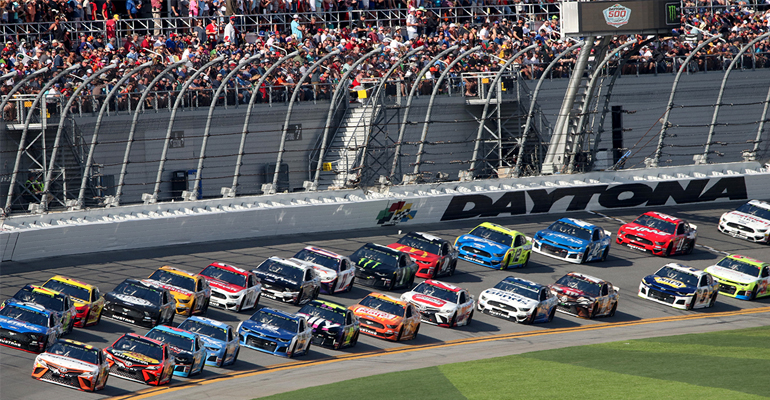
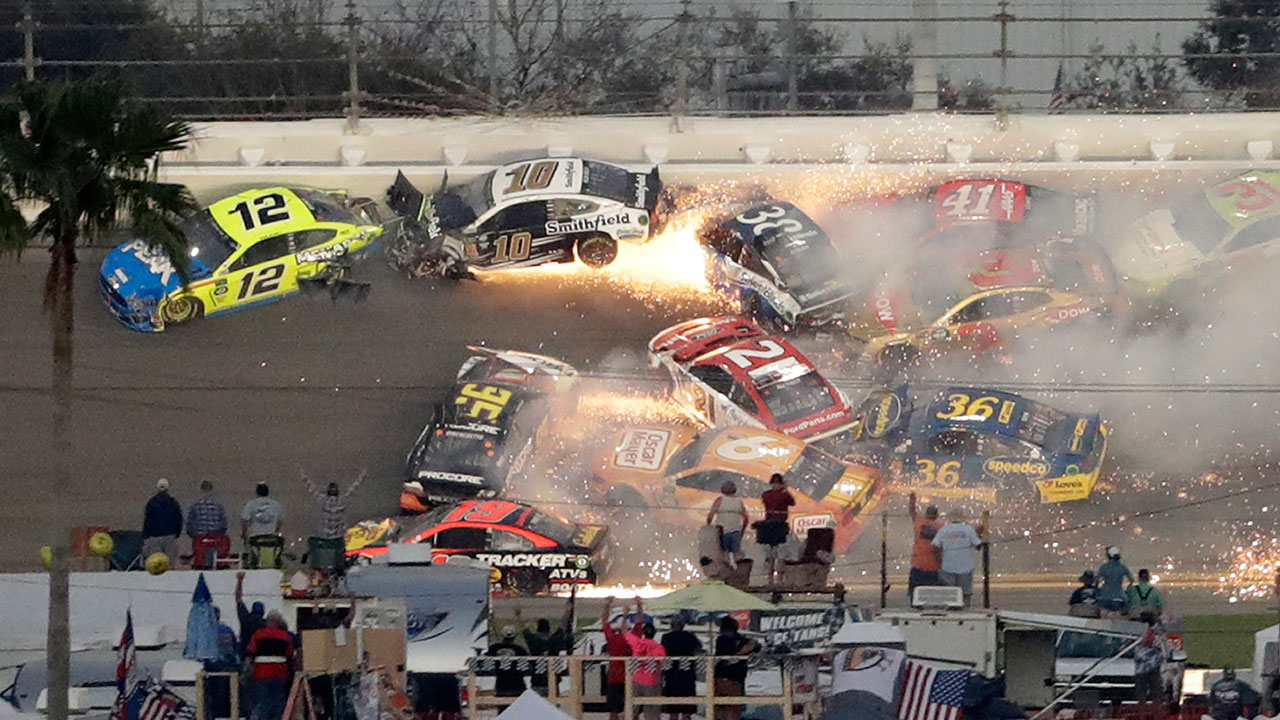
For the second time, this season NASCAR heads to historic Daytona International Speedway. Friday the Xfinity cars will hit the high-banked superspeedway as we are four races away from the round of 12. As we know anytime the cars hit Daytona, or really any superspeedway (mainly thinking Talladega) there is a great deal of unpredictability and virtually anyone has a chance to win. The drivers will go 100 laps, 250 on Friday night. Daytona is a 2.5-mile tri-oval that is heavily banked. The asphalt track banks 31 degrees in the turns and 18 degrees in the tri-oval and if you’ve ever had the pleasure of walking on the track you’d know that it is quite a climb up from the infield to the wall surrounding the track. The major factor or factors we have to deal with at Daytona and Talladega is “the big one(s)”. The big one is a massive wreck that typically takes out anywhere from a quarter to one-third of the field. A wreck like this typically happens once, if not multiple times due to the style of racing required to run on a superspeedway, commonly known as pack racing. When cars are racing at a superspeedway in order to get around the track a quickly as possible we’ll see one, two, and sometimes even three lines form with cars drafting one another mere inches away from each other. If a car gets out of the draft they lose momentum and quickly lose positions on the track. The big one happens when a driver tries to make a move, gets too aggressive, or simply loses control of the car pushing 200 miles per hour. When a bunch of cars are so close to one another in most cases that one or two cars that has the mishap will take out the majority of cars around them. See below.
The most basic, elementary strategy when rostering drivers at Daytona is finding adequate or even just somewhat adequate drivers in decent equipment that are starting in the back, even more so than we would normally want to do searching for PD points. Typically these crashes I touched one will take out multiple cars that are front-running. Earlier this season 18 drivers wrecked out of the race after 114 laps or less. In the race prior, 12 made it just 48 laps or less before the big one came. Hypothetically this will give the drivers towards the back time to adjust and avoid the mayhem on the way by. In the Xfinity race at Daytona earlier this season seven drivers starting 31st or worse finished in the top 15 with A.J. Allmendinger who started 31st finishing fifth, superspeedway ringer Brandon Gdovic finishing eighth after starting 39th, and Jason White, who was running just his first Xfinity race since 2014 finishing 10th after starting 40th. This is often the type of trend we see in these races. As far as dominators go earlier this year just three drivers led 23 or more laps; Ryan Sieg who only lasted 81 laps, Harrison Burton who led 28 and finished third, and Austin Cindric who led 28 from the pole and went on to win. Note: Burton led 28 straight late in the race before a 14-car wreck drew a caution flag. Because of that unpredictability factor of when the big one will come sometimes pinpointing a dominator or two is tricky. In the previous Daytona race, A.J. Allmendinger led a race-high 58 laps before crashing on the final lap and finishing 15th. In the race prior to THAT one, only three drivers led 20 or more laps once again, and wouldn’t you know it, all three ended up crashing and finishing 23rd (Jeb Burton), 30th (Justin Allgaier), and 33rd (Myatt Snider). When building lineups you might end up seeing a couple or even a few drivers that are head-scratchers and a hefty amount of salary left over. Don’t worry about those two situations because of the propensity of these races to be chaotic. The unpredictability of Daytona is what makes it hang onto the edge of your seat until the very end.
Most comparable tracks: Talladega Superspeedway (only difference is how much wider it is than Daytona)
*Note: all pricing is DraftKings focused
Dominators
These are the drivers that we can typically expect to, you guessed it, dominate the race. When we think dominator we are looking for guys that will be in a position to lead a hefty amount of laps as well as be able to turn over fastest laps.
Over the past six races the pole sitter for these Xfinity races has been able to stay out of trouble for the most part and pick up some dominator points.
Last six pole sitters:
Austin Cindric – Finished in 1st – led 28 laps
Chase Briscoe – Finished 3rd – led 22 laps
Myatt Snider – Finished 33rd – led 22 laps – wrecked out of the race on lap 61
Tyler Reddick – Finished 16th – led 6 laps
Tyler Reddick – Finished 9th – led 4 laps
Ryan Preece – Finished 39th – led no laps – engine overheating knocked him out very early
As we see outside of Preece and Snider the other four pole sitters of the last six races have fared decently well but did not score an overwhelming amount of dominator points.
Of the last six Xfinity winners at Daytona just three of those have led 40 or more laps; Kyle Larson (40), Michael Annett (45), Ross Chastain (49)
Dominators at superspeedways are very difficult to handicap but at the Xfinity level, it’s easier to weed out some of the cars/drivers that simply are unlikely to get to the front either because of lack of talent/experience for the driver or sub-par equipment under the hood. Below are a few drivers I could see being potential dominators.
Harrison Burton ($8,000)
Burton will start fifth and is coming off of a third-place finish earlier this season at Daytona in a race he led 28 laps. If not for a late-race caution Burton could’ve easily led a bigger chunk of laps and potentially looked like he was going to win the race. Burton has finished in the top five in each of his last three trips to Daytona in the Xfinity Series, his only three races there in the series and the key is that he’s been able to keep the car clean. It could be that the future driver of the Wood Brothers #21 car has a knack for keeping the car clean on superspeedways. In his three career Xfinity races at Talladega, he’s made it to the finish line twice while crashing just once, his first race there. It can’t be stated enough how important it is to stay out of trouble at these tracks when starting out front in order to have a chance to lead laps and eventually win. To this point in his career, Burton has been able to do that a lot more often than not.
Noah Gragson ($7,600)
One of the more polarizing drivers in the Xfinity Series is Gragson, an incredibly aggressive driver that sometimes could be to his detriment. Gragson will start second and that aggressive style is just what could help him get out to an early lead around pole-sitter A.J. Allmendinger. Gragson found himself in trouble here earlier in the season when he wrecked out after starting fifth. In February of 2020 Gragson won here at Daytona after starting 12th and leading 15 laps in the race (the fifth-most laps led in the race). If he stays out of trouble he should be competitive until the end in a good car. It’ll be a major bonus if he can get out to an early lead and hang out up front through most of the first stage.
Also consider:
Austin Cindric ($8,800) – Also a bonus that he starts 14th so there’s place differential potential here as well.
Justin Haley ($8,600) – Haley and the Kaulig cars overall have shown the ability to perform over the last few years at superspeedways.
Place Differential Targets
This is where the focus should be and where the money is going to be made. Finding the drivers with place differential that can stay out of trouble and see this race to the end is paramount.
Chase Briscoe ($11,500)
Briscoe slides into an Xfinity car this weekend and will start 37th. He’ll be driving the 99 car for B.J. McLeod for the second time this season after driving that car to a sixth-place finish at Charlotte earlier this season. At the Xfinity level Briscoe has finished 12th, 35th (after a crash), fifth, and third at Daytona. A driver of his caliber starting this far back in an Xfinity race means we can expect heavy ownership his way. With that being said, if he were to wreck out and you don’t eat that chalk, that’s a major advantage to have at hand. I tend to think that he’ll be fine as far as navigating through trouble and keep the car pretty clean but, of course, trouble could strike at any moment. I’ll have a hefty amount of Briscoe in my lineups.
Brandon Brown ($10,100)

An Xfinity regular with two top 5’s and seven top 10’s this season, Brown finds himself starting way back in 31st after wrecking in his last two races. Brown finished sixth at Daytona and seventh at Talladega this season; his third career top seven finish at Daytona and third career top 11 at Talladega. Along with Briscoe, Brandon Brown will likely be my highest-owned driver in my lineups.
Jason White ($9,000)
I mentioned White above and he has not been a household name at the NASCAR level. This is good considering that he starts 35th and has found some success almost exclusively running in the superspeedway races at the Xfinity level. In the first Daytona race this season he finished 10th after starting 40th in the 23 car. He’ll be in the 66 car on Friday night and could be an overlooked gem from the back based on lack of name recognition.
J.J. Yeley ($9,200)
Another popular play from the back could be Yeley who will roll off 34th. Yeley has driven eight Xfinity races this season and drove a Cup car at Talladega earlier this season. This will be the seventh time he’s driven the 17 car for Rick Ware this season and he’s finished in the top 20 every time including two top 12 finishes. Yeley finished 12th in the February Xfinity race at Daytona last year so he’s had some recent superspeedway success of late.
Also consider:
Daniel Hemric ($10,700) – Starting 21st, will be lower-owned. Finished ninth at Daytona and 12th at Talladega earlier this season.
Joe Graf, Jr. ($6,100) – Starting 39th, should be popular at this price. I don’t quite understand his salary relative to others starting around him.
Blaine Perkins ($5,400) – Starting 29th, definitely a bit of a longshot play but this is Daytona after all. This will be the fifth race for Perkins in the 23 Our Motorsports car and he’s finished 30th on average, take into account that in his last race the car’s suspension failed him after 78 laps.
Caesar Bacarella ($6,000) – Starting 36th, this will be Bacarella’s eighth career Xfinity race at Daytona. He’s been able to record a 13th place in 2018 and a 12th place finish earlier this season. However, keep in mind that he has wrecked out four times in his previous seven races, so this value play, like Perkins above, certainly comes with some risk-reward.
Speedy Notes
Driver(s) I have most exposure to: Brandon Brown and Chase Briscoe
Driver I’m fading that worries me: A.J. Allmendinger
Driver(s) I have zero interest in: Brandon Jones and Justin Allgaier